Thank you for taking the time to respond to my comment and engage with my blog post. I appreciate your passion for theological discussion and your willingness to share your perspective. However, I believe there are some misunderstandings and misrepresentations of LDS doctrine in your rebuttal that I’d like to address thoughtfully and respectfully. My aim is not to provoke contention but to clarify what Latter-day Saints actually believe, examine the reasoning behind your critique, and foster a meaningful dialogue about God’s nature as revealed in scripture.
Clarifying LDS Doctrine on God and the Virgin Birth
It is claimed that Latter-day Saints believe Jesus was conceived through sexual intercourse between God the Father and Mary, and that Mary therefore was not a virgin when Jesus was born. It is also claimed that Latter-day Saints reject the "Evangelical belief" that "Christ was born of the virgin Mary, who, when the Holy Ghost came upon her, miraculously conceived the promised messiah."
Often used as evidence are a handful statements from early LDS leaders, such as Brigham Young, that directly or indirectly support this idea. However, such statements do not represent the official doctrine of the Church. The key, official doctrine of the Church is that Jesus is literally the son of God (i.e., this is not a symbolic or figurative expression), and Mary was a virgin before and after Christ's conception.
At the annunciation, Mary questioned the angel about how she could bear a child: "How shall this be, seeing I know not a man?" (Luke 1:34; the expression "know" in the Greek text is a euphemism for sexual relations). Nephi likewise described Mary as a virgin (1 Nephi 11:13-20), as did Alma1 (Alma 7:10).
You further claim that when you challenged LDS leadership on this, citing the Bible’s affirmation of Mary’s virginity, they responded that she was “a virgin to mortal man” but not to an immortal God. I respectfully submit that this portrayal does not align with official LDS teachings, and I’d like to clarify the actual doctrine.
God as the Father of Spirits: Yes, Latter-day Saints believe that God the Father is the spiritual Father of all human spirits (Hebrews 12:9). This is a spiritual, not biological, relationship. Mary, like all of us, is a spirit child of God in this sense.
The Conception of Jesus: Official LDS doctrine does not teach that God the Father had physical relations with Mary. The Book of Mormon explicitly states that Mary was a virgin when she conceived Jesus by the power of the Holy Ghost: “And behold, he shall be born of Mary, at Jerusalem which is the land of our forefathers, she being a virgin, a precious and chosen vessel, who shall be overshadowed and conceive by the power of the Holy Ghost, and bring forth a son, yea, even the Son of God.” (Alma 7:10). Similarly, 1 Nephi 11:18-20 describes Mary as “a virgin, most beautiful and fair” who bore a son “after the manner of the flesh” through divine means, not physical intercourse with God. The Bible concurs in Luke 1:35: “The Holy Ghost shall come upon thee, and the power of the Highest shall overshadow thee.” LDS teachings affirm the virgin birth as a miraculous event, consistent with scripture.
Misrepresentation and Anecdote: Your claim that “LDS teaches that their god had sex with her” appears to stem from a misunderstanding or an informal conversation rather than official doctrine. The explanation you attribute to unnamed “LDS leadership”—that Mary was a virgin to mortal men but not to an immortal God—is not found in the standard works (Bible, Book of Mormon, Doctrine and Covenants, Pearl of Great Price) or authoritative statements from the Church. Without specific details or verification, this anecdote lacks credibility and seems to misrepresent what the Church teaches.
In short, Latter-day Saints uphold the biblical account of the virgin birth. The notion of God physically engaging with Mary is not part of our doctrine and contradicts our scriptures. I invite you to consider these references and engage with what we actually believe, rather than a distorted version of our teachings.
Logical Fallacies in Your Rebuttal
Your critique employs several logical fallacies that undermine its persuasiveness and fail to engage with the substance of my arguments. Let me outline these respectfully:
Straw Man Fallacy: You attack a misrepresentation of LDS beliefs—namely, that God had physical relations with Mary—rather than addressing our actual doctrine. By setting up this exaggerated and erroneous claim, you make it easier to dismiss LDS theology without tackling the real issues, such as the nature of God in Hosea 11:9b or the incarnation of Christ. A fair discussion requires engaging with what we truly teach, as outlined above.
Ad Hominem Fallacy: Statements like “I don’t post comments with links to false teachings,” “LDS apologetics twist scripture and revise history to support their cultic beliefs,” and “Anyone who can accept that doctrine has been totally duped and LDS apologetics just keeps them brainwashed into their cult” dismiss my arguments by attacking their source rather than their merit. Labeling LDS beliefs as “false,” “cultic,” or “brainwashing” avoids substantive debate and resorts to name-calling. This sidesteps the theological and scriptural points I raised about Christ as God manifested in the flesh.
Appeal to Anonymous Authority: Your reference to a conversation with unnamed “LDS leadership” lacks specificity—names, dates, or context—that would lend it credibility. Without verifiable evidence, this claim cannot be evaluated and appears as an attempt to bolster your argument with untestable hearsay.
Genetic Fallacy: By suggesting that LDS beliefs are inherently invalid because they come from “Mormonism” (e.g., “Your link showed me nothing I haven’t seen before in my 50 years studying Mormonism after leaving the LDS”), you imply that their origin discredits them, regardless of their content. This overlooks the possibility that scripture and reason might support our perspective, as I’ve sought to demonstrate.
These fallacies weaken your rebuttal by shifting focus from reasoned analysis to misrepresentation and dismissal. I encourage a discussion grounded in scripture and logic, where we can explore our differences constructively.
Hosea 11:9b in Context and the Incarnation of Christ
Your original post cites Hosea 11:9b— “For I am God and not a man, the Holy One in your midst”—to argue that God was never a man, challenging the LDS belief that God the Father was once mortal and is now exalted. My comment asked how you reconcile this with New Testament passages stating that Christ, who is God, became a man (e.g., John 1:14, 1 Timothy 3:16). Let’s examine this exegetically and address the apparent tension.
Context of Hosea 11:9b: Hosea 11 portrays God’s love for Israel despite their rebellion, culminating in a promise of mercy: “I will not execute my burning anger… for I am God and not a man” (Hosea 11:9, ESV). Here, God contrasts His divine attributes—steadfast mercy, holiness, and power—with human tendencies toward fickleness and wrath. The phrase “not a man” emphasizes His current divine nature, not a categorical denial that God could ever take on human form or have a mortal experience. It’s about God’s transcendence over human limitations in this moment of compassion.
Christ as God Manifested in the Flesh: The New Testament clearly teaches that Jesus Christ is divine and became human: John 1:14: “And the Word became flesh and dwelt among us, and we have seen his glory, glory as of the only Son from the Father.”
1 Timothy 3:16: “He was manifested in the flesh, vindicated by the Spirit… taken up in glory.”
Colossians 2:9: “For in him the whole fullness of deity dwells bodily.” In traditional Christianity, the incarnation—God the Son taking on humanity—coexists with His divine nature via the hypostatic union. If Christ is God and became a man, your assertion that “God is not, nor ever was, a man” seems to conflict with this reality unless qualified.
Traditional Reconciliation: You might argue, as in your initial reply, that the Trinity resolves this: God the Father remains a spirit, while God the Son became incarnate without altering the divine essence. Hosea 11:9b, then, applies to God’s immutable nature, not precluding the Son’s unique human experience. This hinges on Trinitarian distinctions, which I respect as your framework.
LDS Reconciliation: From an LDS perspective, Hosea 11:9b highlights God’s exalted state, not a denial of past mortality. We believe God the Father may have been mortal in the distant past, progressing to divinity, much as Christ did (see Joseph Smith’s King Follett Discourse). Christ, divine as Jehovah, became mortal to redeem us, then resumed His glorified state (Doctrine and Covenants 93:11-17). Hosea’s declaration reflects God’s current transcendence— “not a man” in frailty—without negating a prior mortal phase. The incarnation of Christ supports this: if God the Son could become man, it’s plausible the Father followed a similar path eons ago.
Bridging the Gap: Both views affirm Christ’s divinity and humanity but differ on God’s broader nature. Your interpretation sees Hosea as proof of eternal immutability; mine sees it as a statement of present divinity within eternal progression. The New Testament’s witness of Christ as God in the flesh challenges an absolute “never was a man” stance unless contextualized, which both our theologies attempt in distinct ways.
Additional Fallacies and a Call to Dialogue
Beyond the fallacies noted, your rebuttal oversimplifies complex theological issues. For instance, dismissing LDS apologetics as “twisting scripture” assumes malicious intent without evidence, ignoring how all traditions interpret scripture through their lenses. Your focus on a sensationalized claim (God and Mary) diverts attention from my core question about Christ’s incarnation, a tactic resembling a red herring.
I invite you to reconsider my actual arguments:
The contextual meaning of Hosea 11:9b as God’s mercy, not a denial of mortality.
The New Testament’s affirmation that Christ, as God, became man.
The LDS view of eternal progression as consistent with Christ’s example.
Rather than dismissing these as “false teachings,” let’s explore them scripturally. I’m open to a respectful exchange that honors our shared love for God and His word, focusing on reason over rhetoric. What are your thoughts on John 1:14 in light of Hosea 11:9b? How do you see Christ’s humanity fitting with your claim? I look forward to your insights.
Update: Glenn E. Chatfield's Recent Response
Rebuttal to Glenn E. Chatfield’s Comment
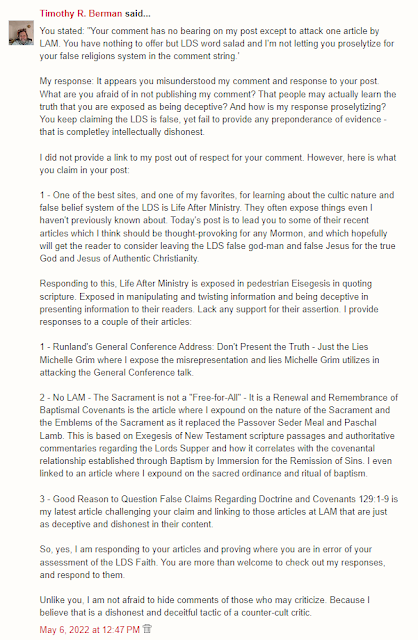
What follows is the flow of discussion at Glenn E. Chatfield's The Anti-Mormon blogger post titled: God is NOT, nor ever was, A Man. My response to him (which he does not want to publish to his blogger post - and thus may cause confusion among those who may happen upon his content and seeing the discussion) addresses the typical attitude and behavior most critics of the LDS Faith (specifically, those who are apostates) engage in when their claims and assertions are scrutinized and challenged. They tend to become defensive, condescending, almost ridiculing and mocking. Shutting down any actual discussion. Also, the reader will see the screenshot of the actual discussion at the blog post and notice the missing commentary from this writer (which is included in this blog post).
Is it considerate to say that you are not interested in the truth and possibility of being wrong? I posted my response to your rebuttal and address it. I am not afraid of the truth. In fact, if it is adequately shown through sound and reasonable understanding and sufficient evidence, I am willing to admit I am wrong. Are you capable of saying the same thing?
It seems there appears to be an attitude and behavior that is more ego driven and prideful that is more arrogant than one of humility and willingness. It seems you come off as lacking any sense of humility.
I've shown respect in responding to you, attempting to correct and point out possible flaws in your arguments, and yet, it is consistently met with words of harshness, arrogance, and condescending attitude.
Additionally, it seems to do your readers a disservice of providing a response to my comment without your readers actually seeing my comments you are responding to. Almost as if you are attempting to gloat pridefully a way of showing how critics engage in typical ranting behaviors when challenged.
You are more than welcomed to come and discuss these issues. I won't delete your comments, nor will I use condescending loaded language and arguments that are riddled with logical fallacies.
Regardless - you do not have any real authority and understanding on the subject matter since you lack proper communication and respectful engagement.
His response to this:
Glenn E. Chatfield
It is YOU who is not interested in the truth about the LDS. I have not shown you disrespect, gave you no words of harshness or a condescending attitude. I just don't want to waste time with someone who denies the LDS is nothing but a cult built on a false prophet and doctrines built on lies. Your rebuttal was just claiming logic fallacies but if what I stated was true then there is no fallacy.
I never post comments which included false teaching or links to false teachings.
Again, I have studied the LDS for 50+ years and have seen all the LDS apologetics arguments. I KNOW I am not wrong about LDS teachings. Refusing to debate you is not about ego or pride, it's about not wasting time with someone who just wants to defend the LDS cult.
Mr. Chatfield,
Your recent comment—
“Mr. Berman, I am not going to have a dialogue with you because you are not interested in the truth of Mormonism. I have plenty of proof about the LDS god having sex with Mary. Just look on my index on the right side and see the link to articles on the topic. Take your LDS defense elsewhere—I’ve heard it all”
—reflects a stance that, while rooted in conviction, raises concerns about logical consistency, openness to discussion, and the strength of your authority on this topic. I offer the following response with respect and a desire for constructive dialogue, addressing three key aspects of your comment.
1. Logical Fallacy: Appeal to Authority
Your assertion that “I have plenty of proof” followed by a directive to “look on my index… to articles on the topic” suggests an appeal to authority—a logical fallacy where the validity of a claim is assumed based solely on the authority of external sources, without engaging directly with the evidence or counterarguments. While these articles may contain compelling points, deferring to them without discussion does not inherently validate your position. Truth in religious matters, such as the claim about the LDS god and Mary, often hinges on interpretation and context, both of which can vary across sources. By refusing to elaborate or address potential challenges, you leave your argument vulnerable to the critique that it relies on unexamined authority rather than reasoned analysis. A stronger approach would involve presenting your evidence directly and engaging with opposing views to demonstrate its robustness.
2. Observable Attitude and Behavior: Dismissiveness and Prejudgment
Your statement, “I am not going to have a dialogue with you because you are not interested in the truth of Mormonism,” coupled with “Take your LDS defense elsewhere—I’ve heard it all,” reveals a dismissive and confrontational attitude. This response prejudges my intentions, assuming a lack of interest in truth without evidence, and shuts down discussion before it can begin. The phrase “I’ve heard it all” further implies that any defense or alternative perspective is unworthy of consideration simply because it is familiar to you. Such behavior suggests a reluctance to have your views scrutinized, which comes across as arbitrarily dismissive. Openness to dialogue—even with those who disagree—signals confidence in one’s position, whereas this approach risks appearing defensive and closed-off, limiting the potential for mutual understanding.
3. Impact on Credibility and Authority: Diminished by Arbitrary Dismissiveness
The combination of refusing dialogue and relying on external sources without engagement continues to erode your credibility and authority on this subject. Credibility rests not just on what you know, but on your willingness to defend it through reasoned exchange. By dismissing discussion with an air of finality, you appear evasive, which may lead others to question the strength or depth of your understanding. Authority is bolstered by demonstrating a capacity to address challenges head-on, yet your arbitrary dismissiveness— “Take your LDS defense elsewhere”—suggests a lack of confidence in confronting counterarguments directly. This approach alienates those who might otherwise engage with your perspective, reducing its persuasive impact and casting doubt on your ability to represent the topic with nuance or fairness.
4. An Invitation to Constructive Engagement
I respectfully encourage you to reconsider this stance. Dialogue does not demand agreement, but it does offer an opportunity to refine and strengthen your position through scrutiny. If you believe strongly in your proof regarding the LDS god and Mary, presenting it openly and addressing counterpoints would only enhance your credibility. Arbitrary dismissiveness serves neither your argument nor the pursuit of truth; it deepens divisions rather than bridges them. I invite you to share your perspective directly—perhaps by summarizing the key evidence from your articles—and engage with any questions or challenges that arise. Such an approach would reflect both intellectual rigor and a genuine commitment to understanding, qualities that elevate authority far more than a reliance on external references alone.
In closing, while I respect your conviction, I urge you to reflect on how this dismissive tone and avoidance of discussion may weaken your influence. Truth, to resonate, must stand up to inquiry, not sidestep it. I remain open to a thoughtful exchange, should you choose to pursue one.
Mindful Latter-day Saint Apologetics: Defending Faith with Clarity & Confidence
Welcome to a thought-provoking exploration of Latter-day Saint Apologetics, where faith meets reason. This AI-generated podcast is based on four published articles offering faithful, well-reasoned, and effective responses to ongoing criticism of Latter-day Saint beliefs, teachings, history, and doctrine.
📖 In this episode, we cover: ✔️ How to thoughtfully navigate and respond to anti-Mormon rhetoric ✔️ Identifying and addressing toxic apologetics and faith-damaging discourse ✔️ Defending Latter-day Saint Christian beliefs with intellectual rigor and spiritual strength ✔️ The impact of social media on faith and how to remain resilient
💙 Support This Work & Make a Difference! If this podcast and YouTube channel bring value to you, please consider donating to sustain and expand this vital effort. Your urgent financial support ensures we continue producing faith-building content. Every contribution—big or small—is deeply appreciated.
📌 Subscribe, Like, & Share to help spread truth and defend faith with strength and understanding! #LDSApologetics #MormonFaith #LatterDaySaints #DefendingTheFaith #ChristianApologetics #FaithfulAnswers #ToxicApologetics #ResilientFaith #GospelTruth
Join our Mindful Latter-day Saint Christian Living & Apologetics community today for $10.00 per month or $120 per year. Arm yourself with knowledge, build your testimony, and engage with faith-focused insights that uplift and inspire. Subscribe now for full access!
In an era where social media amplifies criticism and contention, members of The Church of Jesus Christ of Latter-day Saints face an increasing wave of digital opposition. From historical distortions to modern ideological pressures, faith is often put on trial in the court of public opinion. Critics—both external and internal—use social media to challenge, mock, and undermine core beliefs, creating confusion and division among faithful members. This exclusive deep dive into the phenomenon of Latter-day Saint-baiting sheds light on the history, tactics, and evolving digital landscape of these attacks—and, most importantly, how members can fortify their faith in the face of opposition.
Understanding the History of Religious Criticism
Religious opposition is not new, but the rise of Mormon-baiting—a targeted strategy to provoke and discredit faithful members—has evolved significantly. From 19th-century anti-Mormon literature to 20th-century evangelical counter-cult movements, critics have long sought to redefine the Church’s message through misinformation. Now, in the 21st century, viral posts, algorithm-driven engagement, and ex-Mormon influencers continue this trend, adapting old criticisms for a digital audience.
Modern-Day Faith Challenges: The Social Media Battleground
Today’s critics weaponize online platforms, often distorting Church teachings, spreading half-truths, and using emotional manipulation to foster doubt. This investigation examines:
The rise of ex-Mormon influencers who frame their departures as moral awakenings, encouraging others to follow.
Evangelical apologists who use selective doctrine to paint Latter-day Saints as non-Christian.
Internal critics who challenge Church leadership and doctrine, pushing for alignment with societal trends.
Through these tactics, critics aim to erode faith by presenting their narratives as the “real truth.” Their influence extends beyond theology, affecting discussions on gender, race, politics, and historical controversies.
How to Strengthen Your Testimony Amidst Criticism
In a world where faith is publicly scrutinized, it’s critical to strengthen testimony, recognize manipulative tactics, and engage with wisdom and love. This exclusive content provides practical strategies for navigating online debates, maintaining spiritual resilience, and ensuring that personal faith remains unshaken. Topics include:
Discerning misinformation and emotional manipulation in social media debates.
Responding with clarity, confidence, and Christlike love when facing antagonism.
Building resilience through scripture study, prayer, and prophetic guidance.
Leveraging social media positively to amplify faith-based messages.
Exclusive Access: Equip Yourself with Truth
This deep-dive article is part of a premium collection designed to empower Latter-day Saints to navigate modern faith challenges with confidence. As a subscriber, you gain access to exclusive faith-based content, in-depth apologetics, and strategies for strengthening personal discipleship in an increasingly polarized world.
There is an endless stream of criticism against the beliefs, traditions, and views of the Latter-day Saint Christian Faith. These criticisms consistently surface and always lack a fair or informed understanding of what the Restored Gospel actually teaches. Glenn E. Chatfield's recent post, titled "God Had a Father God?" is one such example. And it is not the first time this topic has been brought to my attention - I've already addressed a similar criticism presented by Life After Ministry - where there is a clear misconception. Chatfield merely offered his thoughts and linked to Life After Ministry blog post.
Chatfield also claims that he refutes the LDS on his blog using nothing more than LDS teachings and scriptures. This is not what is in dispute. What is questionable is how he is using LDS Teachings and Scriptures in a way that presents the teachings and doctrines of the Latter-day Saint faith in a false manner. This is accomplished by cherry-picking quotes and scriptures, building strawman arguments, deflection, and even engaging in ad hominem against past and present leaders. Not only that, but critics also tend to project and insult any who may be a Latter-day Saint and attempt to engage in discussion with them. Take for example Chatfield's recent comment to an anonymous commentator:
One of Chatfield's posts, dated May 5, 2022, titled Good Stuff to Peruse, I engaged in a discussion with him regarding this issue. Here is his response:
What was he responding too? Here is my comment.
The point of this is that the individual guilty of any ad hominem is Glen E. Chatfield. Here are some of the personal insults he has used to attack anyone willing to step up to correct any misinformation and refute any erroneous information that is deceptive and manipulative.
He is a cult member defending false teachings: It is inflammatory and outright slanderous
LDS is a demonic and false system: Arbitrarily dismissing any Latter-day Saint and calling them demonic and false.
LDS Apologists merely cause confusion: Again, further dismissal of any rational discussion.
Joseph Smith a lying and false Prophet: insulting and attacking Joseph Smith without evidence and rational thought.
The observable attitude and behavior of critics like Chatfield also show that they are entrenched in such toxic apologetics where they do not hold themselves to the same expected standards of respect that is imposed on others. Meaning, they flippantly call people out for perceived personal insults when they are themselves the one doing the insulting and personal attacks. This is called projection. Critics attempt to push their own insecure and inadequacies upon others and then blame them for the exact behavior they are observed in doing.
The particular criticism that centers around the Latter-day Saint belief of God's nature and the idea God may have had a Father is misconstrued. First, it is oversimplified and framed in a way that does sound quite absurd. On this point - Chatfield is correct. Only correct in the sense that he is manipulating and regurgitating previous information in a way that does sound absurd. Second, it speaks to the nature of how critics, and those who are apostates, are merely lazy learners because often times they do not put forth any effort, energy, and time to honestly engage with the theological nuances of the LDS Faith. Critics often have a rally cry of superiority. "I was a member, I know what I am talking about" or a list of callings and positions of some low hanging fruit of authority. It does not amount to a hill of beans - what matters is whether they are willing to consider the possibility that they may very well be wrong. Sadly, Chatfield, like most critics in my experience of various discussions over the decades of apologetics, is staunch in that they are 100% Correct and use LDS Teachings and scriptures to prove how wrong the LDS Faith is. It is strutting around like a peacock and pontificating intelligence when in reality they are peddling wares of lies and deceptions. Causing confusion and faith crisis and essentially lying in wait to deceive (Ephesians 4:14-15).
Therefore, my aim is to respond to Glenn E. Chatfield (as I know he won't allow me to publish a comment on his post because has articulated how he does not want his audience to be "confused" or "deceived"). It also will shed light on what has already been established addressed regarding the claim is deemed quite absurd.
Rebuttal to Glenn E. Chatfield's Post: God Had a Father God?"
Chatfield's post, that is under scrutiny and examination here, reflects several common misconceptions about LDS teaching, doctrine, and faith. Granted, it is important to take the time to have a cohesive and rational discussion where there are theological differences. However, it is Chatfield's observable attitude and behavior regarding the tone, arguments, and presentation that call into question his credibility and undermine his assertions. He relies heavily on logical fallacies (as well as Life After Ministries). And when he engages in any discussion, it is observed to come from a condescending attitude that lacks empathy, compassion, and genuine engagement. Quite uninviting. He does little to foster any meaningful conversation. Nor does he accurate represent what Latter-day Saints actually believe in - no matter how often he may claim that he is merely quoting LDS teaching, leaders, and scriptures.
Chatfield's presenting argument relies on the following fallacies:
1. Straw Man Fallacy: By grossly misrepresenting LDS teaching and beliefs about God's nature, through oversimplification and caricaturing the LDS beliefs, Chatfield reduces the idea of God having a Father to a mere crude notion of an endless chain of God's (infinite regression idea and teaching interpreted by numerous counter-cult ministries and apostates over the years).
2. False Equivalence: Chatfield claims that the LDS God is "nothing like the God of the Bible". By this reasoning, he is implying that because our understanding differs from creedal Christian belief - it is deemed unbiblical and indefensible. This argument fails in acknowledging how LDS theology is deeply rooted in scripture. This includes teachings about divine parentage (e.g., Hebrews 12:9, which refers to God as the Fathers of spirits). Furthermore, Latter-day saints affirm the divine and omnipotent and eternal nature of God. Aligning closely to the Biblical foundation - even if additional revealed truths expand upon these ideas.
3. Appeal to Ridicule: Employing trigger phrases, like "this is one of those absurd doctrines" are not theological or rational arguments. They are rhetorical mechanisms designed to arbitrarily dismiss LDS beliefs outright. Such hostile and passive aggressive language comes across as arrogant, condescending, and prideful. As such, it discourages any productive and rational discussions. It also reveals a lack of respect for differing perspectives.
4. Circular Reasoning: Chatfield, assuming that the creedal Christian perspective and worldview of God is the only valid interpretation, uses it as the standard by which LDS doctrine and teaching is measured. Doing so, he disregards the plausibility that LDS Teachings offer greater insights due to restored truths that were once lost or obscured.
Addressing the Tone of Condescension and Arrogance
Chatfield’s tone is unnecessarily condescending, as evidenced by statements like “And LDS claims they are Christian?!?!” Such rhetorical flourishes reveal an underlying assumption that his interpretation of Christianity is definitive, leaving no room for differing perspectives. This attitude not only alienates Latter-day Saints but also undermines his credibility as someone seeking genuine theological engagement.
Respectful dialogue should aim to understand the beliefs of others rather than mock them. Latter-day Saints unequivocally affirm Jesus Christ as the Son of God, the Savior of the world, and the central figure in God’s eternal plan. Questioning our Christian identity without careful consideration of our faith’s Christ-centered foundation comes across as dismissive rather than constructive.
The LDS Perspective on the Godhead: Monarchial Monotheism
When properly examined, Latter-day Saint theology reflects a monarchial monotheistic view of the Godhead, distinct yet compatible with biblical principles. This perspective acknowledges one God—God the Father—who reigns supreme, with His Son, Jesus Christ, and the Holy Ghost united in purpose and divinity.
The doctrine of divine parentage and eternal progression, as cited by Orson Pratt in The Seer (p. 132), does not detract from the supremacy of God the Father but rather emphasizes His role as the ultimate source of life and creation. The idea that we are “begotten by our Father in Heaven” and that He, in turn, was begotten by a Father aligns with the biblical notion of God as the “Father of spirits” (Hebrews 12:9) and the principle that “as man is, God once was; as God is, man may become” (Lorenzo Snow). This understanding highlights the eternal nature of God’s work and glory: to bring to pass the immortality and eternal life of His children (Moses 1:39).
Far from being a “chain of gods” that diminishes God’s majesty, this doctrine expands our understanding of His eternal nature and His love for us as His children. It underscores the biblical truth that we are created in His image (Genesis 1:27) and invites us to strive for spiritual growth and eventual exaltation through the grace of Jesus Christ.
Conclusion
Glenn E. Chatfield’s critique reflects a misunderstanding of Latter-day Saint theology and relies on logical fallacies, misrepresentation, and dismissive rhetoric. In contrast, LDS doctrine offers a profound and biblically grounded understanding of God’s nature, the Godhead, and our divine potential as His children.
Rather than dismissing LDS beliefs as “absurd,” I invite critics like Chatfield to engage in sincere study and dialogue. By doing so, we can move beyond condescension and ridicule and work toward mutual understanding, even in the face of theological differences.
Understanding Evangelical Criticisms: An LDS Perspective on Faith, Debates, and Mutual Respect
The relationship between Evangelicals and Latter-day Saints is rich with shared hopes and honest differences, yet it's often clouded by misunderstanding. Criticisms aimed at LDS beliefs can, at times, feel personal or even dismissive, but they’re also an opportunity for meaningful dialogue. By approaching these moments with both faith and respect, we can better address concerns without compromising kindness. For Latter-day Saints, understanding the roots of these critiques—and responding with clarity and empathy—can strengthen our own spiritual foundation while fostering genuine conversations about the Restored Gospel.
The Ongoing Debate: Are Latter-day Saints Christians?
The question of whether Latter-day Saints (LDS) are Christians has sparked decades of debate, particularly between members of The Church of Jesus Christ of Latter-day Saints and Evangelical Christians. At its core, the disagreement revolves around differing interpretations of theology, scripture, and historical Christian identity. Despite the clarity offered by LDS theology on its belief in Jesus Christ, the conversation persists due to both theological and cultural differences.
Defining Christianity: The Role of Creeds and Scripture
When Evangelicals discuss Christianity, they often rely on historical creeds such as the Nicene Creed, which serves as a formal declaration of Christian doctrine. These creeds were developed centuries after Christ to unify beliefs about the nature of God and Jesus Christ, particularly focusing on the Trinity. To many Evangelicals, affirming these creeds is essential to being considered a Christian.
Latter-day Saints, however, approach the concept of Christianity differently. They do not recite or endorse these creeds, as they believe early post-apostolic councils marked a departure from the original teachings of Christ. Instead, they emphasize their unique canon of scripture—including the Book of Mormon, Doctrine and Covenants, and Pearl of Great Price—alongside the Bible, as a restored continuation of Jesus's gospel. This distinction often leads to disagreements, as critics argue that rejecting traditional creeds equates to rejecting Christianity itself.
Yet, from another perspective, Christianity is not solely defined by ancient councils or creeds but by a commitment to follow Christ. By this broader definition, Latter-day Saints openly identify as Christians because they worship Jesus Christ as the Savior of humanity and make His teachings the foundation of their faith. This theological divergence shows that "Christianity" can mean different things to different groups.
The LDS Perspective on Jesus Christ
For members of The Church of Jesus Christ of Latter-day Saints, Jesus Christ is the central figure of their theology. They believe He is the Son of God, the promised Messiah, and the Redeemer of the world. LDS doctrine affirms the divinity and mission of Jesus, emphasizing both His premortal role in creating the earth and His atoning sacrifice as the cornerstone of salvation.
Here's how Latter-day Saints describe their relationship with Christ:
The Atonement: Central to LDS belief, the Atonement of Jesus Christ covers both physical death and personal sin. They teach that His suffering in Gethsemane, crucifixion, and resurrection made eternal life possible for all.
Christ’s Authority: Latter-day Saints believe Christ restored His church through Joseph Smith, ensuring it carries His divine authority. This restoration reinforces their connection to Him as the head of their faith.
Personal Relationship: Members frequently testify of a personal, direct relationship with Jesus Christ, achieved through prayer, repentance, and striving to live His teachings.
Despite these teachings, critics point to differences in how LDS theology frames the relationship among God the Father, Jesus Christ, and the Holy Spirit. Unlike the Trinity as defined in historical creeds, Latter-day Saints teach that these three beings are separate individuals united in purpose. This distinction is sometimes seen by others as a deviation from Christian orthodoxy, even though LDS doctrine remains centered on Jesus.
Why This Debate Persists
So, why does this debate linger? The reasons are layered, encompassing both theological concerns and cultural dynamics.
Definitional Disputes: Many Evangelical Christians hold that adherence to specific doctrines, such as the Triune God as defined in the Nicene Creed, is non-negotiable for Christian identity. Latter-day Saints, however, interpret scriptures differently and reject the need for post-biblical creeds, favoring ongoing revelation. This clash of definitions creates an ongoing impasse.
Cultural Disconnects: Beyond theology, cultural undercurrents fuel this debate. LDS practices, such as their missionary efforts, temple worship, and emphasis on modern prophets, are often unfamiliar to Evangelicals. This unfamiliarity can lead to perceptions of Mormonism as "other" rather than a branch of Christianity.
Competition for Souls: Both groups emphasize missionary work, which unavoidably leads to tension. Some Evangelicals may view the LDS Church as a rival religion in the effort to bring people to Christ. Similarly, Latter-day Saints may feel unfairly targeted when their intentions and faith are questioned.
Historical Context: The roots of this debate stretch back centuries. Evangelical critiques often stem from longstanding concerns over LDS doctrine, while Latter-day Saints see their faith as a restoration of Christ’s original teachings. This dynamic keeps the conversation alive, even as LDS members assert their place within the broader Christian community.
In short, this debate endures because of fundamental differences in how each group views God, scripture, and authority. But beneath these differences lies an opportunity for mutual understanding and respectful dialogue—if both sides are willing to listen.
The Nature of God: One God or Many?
When it comes to understanding the nature of God, Evangelicals and Latter-day Saints (LDS) diverge on foundational theology. At the center of this discussion is the question: is God a singular being in three persons, or three distinct beings united in purpose? This section explores both perspectives while addressing common criticisms about the Latter-day Saint view of the Godhead.
The Evangelical View of the Trinity
Evangelical Christians believe in the doctrine of the Trinity, which states that God is one in essence but exists as three co-eternal, co-equal persons—God the Father, God the Son (Jesus Christ), and God the Holy Spirit. While distinct in their relational roles, they are of the same divine substance. This teaching is deeply rooted in historical Christian creeds, such as the Nicene Creed, which formalized this understanding in the fourth century.
For Evangelicals, the Trinity is seen as a mystery that transcends human comprehension but is supported by scripture. For example:
Matthew 28:19 refers to baptizing in the name of the Father, Son, and Holy Spirit.
John 10:30 emphasizes Jesus stating, "I and the Father are one."
2 Corinthians 13:14 highlights the triune nature in Paul’s epistle.
Evangelicals often emphasize that the Trinity preserves strict monotheism, rejecting any interpretation that suggests polytheism or tritheism. They see God as one being but manifesting eternally in three persons who are inseparable in their existence and work.
LDS Belief in the Godhead
In contrast, Latter-day Saints hold a different view of the Godhead. While they also recognize God the Father, Jesus Christ, and the Holy Ghost as divine figures, they reject the notion of a singular essence shared by three persons. Instead, they believe these entities are three distinct beings united in purpose, will, and love. Each member has unique attributes and roles, working together harmoniously in perfect unity.
Latter-day Saints often point to scriptural examples that demonstrate the separateness of the Godhead:
Jesus’ Baptism (Matthew 3:16-17): The Father’s voice, the Son’s physical presence, and the Holy Ghost descending as a dove clearly depict three separate beings.
Acts 7:55-56: Stephen sees Jesus standing at the right hand of the Father, reinforcing their distinctness.
John 17:11, 22: Jesus prays for His disciples to be "one" as He and the Father are one, highlighting unity of purpose rather than essence.
Unlike traditional Christianity, LDS theology teaches that God the Father and Jesus Christ have glorified physical bodies, while the Holy Ghost is a spirit. Critics often label this perspective as polytheistic, but Latter-day Saints argue that the Godhead’s complete unity makes them "one God" in a functional and relational sense.
Historical and Scriptural Arguments for the LDS View
Latter-day Saints turn to both scripture and historical insight to defend their belief in the Godhead. Early Christian writings and biblical accounts provide a foundation for this interpretation.
Biblical Evidence of Distinction:
Genesis 1:26: "Let us make man in our image" suggests a conversation among divine beings.
Psalm 82:6: "Ye are gods," interpreted by Latter-day Saints to support the plurality of divine beings.
Post-Apostolic Shifts: LDS scholars argue that after the deaths of the apostles, a gradual blending of Hellenistic philosophy with Christian teachings led to the development of doctrines like the Trinity. Terms such as "ousia" (essence) used in the Nicene Creed are seen as reflecting Greek metaphysical concepts rather than biblical theology.
Restoration of Truth: Joseph Smith’s First Vision plays a pivotal role in LDS apologetics. In this vision, God the Father and Jesus Christ appeared as separate, glorified beings, affirming the Latter-day Saint understanding. Modern revelations, such as those found in the Doctrine and Covenants, expand on this restored doctrine of the Godhead.
Historical Christian Writings: Early Christian theologians, like Justin Martyr and Origin, made statements that some interpret as aligning more closely with the LDS perspective. For instance, Justin spoke of the Father as the supreme God and the Son as subordinate, a view that differs from the co-equal framework of the Trinity.
Latter-day Saints also challenge the doctrine of "creation ex nihilo" (creation out of nothing), which became central to Trinitarian theology. Instead, they teach "creation from existing material," emphasizing that God organizes pre-existing matter. This aligns with their understanding of God as a relational and knowable being.
By drawing on scripture and historical shifts in Christian thought, Latter-day Saints aim to show that their concept of the Godhead restores original biblical teachings. Critics who dismiss it as polytheistic may misunderstand its emphasis on unity rather than singularity. LDS theology asserts that these differences do not contradict faith in Jesus Christ but reflect a broader, restored view of His divine mission.
Scriptural Additions: The Book of Mormon and Open Canon
The discussion surrounding scripture often highlights a significant divide between Evangelicals and Latter-day Saints (LDS). Evangelicals generally hold firm to the concept of a "closed canon," whereas Latter-day Saints embrace the idea of an "open canon" that includes modern revelations. This contrast goes beyond just theological disagreement—it reflects differing views on how God speaks to His children. Let’s dive into this topic and break it down.
Evangelical Concerns Over Adding to the Bible
For many Evangelicals, the idea of adding to scripture goes against their understanding of biblical authority. They frequently cite verses such as Revelation 22:18-19, which warns against adding to or taking away from the "words of the prophecy of this book." While this passage specifically refers to the Book of Revelation, Evangelicals often interpret it as a warning against any further revelation beyond the Bible as a whole.
The basis of these concerns lies in the belief that the Bible represents God's complete and final word to humanity. After the apostolic era, they argue, authoritative revelation ceased, leaving the Bible as the singular guide for faith and salvation. This theological framework is deeply tied to the historical development of Christianity, particularly during the formation of the biblical canon.
Here’s how these concerns often manifest:
Finality of Revelation: Evangelicals view the Bible as sufficient for all doctrine and guidance. Any new revelation is considered unnecessary or even heretical.
Authority of Apostles: They see the apostles as uniquely qualified to deliver divine teaching. Since the apostolic age ended, no one else holds the authority to contribute to scripture.
Misuse of Authority: There’s a worry that additional scripture opens the door to doctrinal errors or human manipulation of sacred texts.
While these arguments are heartfelt, they stem from a fundamentally different understanding of scripture when compared to that of Latter-day Saints.
The LDS Defense of the Book of Mormon
For members of The Church of Jesus Christ of Latter-day Saints, the Book of Mormon is not an addition to the Bible—it’s a companion to it. They view it as "Another Testament of Jesus Christ," intended to clarify and reinforce God’s teachings. Latter-day Saints argue that God’s ability to speak to His children didn’t end with the apostles or with the Bible’s canonization.
Here’s why the Book of Mormon and an open canon are central to LDS theology:
God’s Continuing Communication: Latter-day Saints affirm that God communicates with people today just as He did in biblical times. Prophets, like those in ancient Israel, reveal His will in every age.
Restoration of Lost Truths: The Book of Mormon is seen as restoring plain and precious truths that were lost or distorted through centuries of translation and interpretation of the Bible.
Unity of Scripture: LDS teachings emphasize that the Book of Mormon complements the Bible. Far from diminishing it, they believe it enriches one’s understanding of Christ’s mission and the plan of salvation.
Consider examples from the Book of Mormon that underscore its spiritual significance:
The Sermon at the Temple in 3 Nephi mirrors Christ’s Sermon on the Mount, offering additional context and guidance.
Passages in 2 Nephi expand on the doctrine of grace, repentance, and the purpose of mortality in ways that resonate with biblical teachings.
Through the testimony of ancient prophets like Nephi and Alma, readers gain another perspective on universal themes of faith, redemption, and God’s enduring love.
For Latter-day Saints, modern revelation—including the Book of Mormon—testifies that God’s work is ongoing. To shut the door on further divine communication would be to limit God in their minds.
Why This Debate Remains Unresolved
The disagreement over additional scripture remains a significant barrier between Evangelicals and Latter-day Saints. At its core, the debate revolves around two fundamentally different questions: What is scripture, and who has the authority to declare it?
From the Evangelical perspective:
Scriptural Authority is Closed: They see scripture as unchanging and complete. Modern revelations—or claims to them—are viewed as undermining the sufficiency of the Bible.
Guarding Against Heresy: Caution is emphasized to protect the integrity of biblical teachings, which Evangelicals believe have already been divinely established and preserved.
From the LDS perspective:
Scriptural Authority is Open: They believe God’s work continues in every dispensation. Just as He revealed His will through prophets in ancient times, He continues to do so through modern prophets today.
A Living Church: Latter-day Saints consider ongoing revelation as evidence of God’s active role in guiding His Church. Without it, they believe the Church would lose its divine direction.
This disagreement is also tied to broader historical and cultural factors:
Varying Canons Historically: Early Christianity lacked a fully agreed-upon canon. While the 66 books of the Protestant Bible are standard for most Evangelicals, Latter-day Saints often point to variations in Catholic and Orthodox canons as proof that “closed canon” claims are subjective.
Interpretive Differences: Evangelicals focus on certain biblical warnings, like the one in Revelation, to argue against additions. Latter-day Saints counter that these warnings refer to specific contexts, not the Bible as a whole.
Faith in Modern Prophets: Evangelicals see modern prophetic claims as dangerously self-serving, while Latter-day Saints view them as central to God’s plan for guiding humanity.
Ultimately, this debate reflects a deeper divergence in the way each faith approaches the questions of authority, revelation, and tradition. While agreement may feel out of reach, the conversation offers an opportunity for both groups to explain their beliefs and grow in mutual understanding.
Salvation: Faith, Grace, and Works
The doctrine of salvation is a cornerstone of Christian belief, and it’s also at the heart of some of the most persistent criticisms aimed at The Church of Jesus Christ of Latter-day Saints. Evangelical Christians often argue that LDS teachings place more emphasis on works than grace, leading to charges of doctrinal error. But is this criticism fair, and how do Latter-day Saints explain the interplay of faith, grace, and works? Let’s break it down.
Evangelical Criticism: Works vs. Grace
One of the most common doctrinal criticisms from Evangelical Christians centers on the belief that salvation comes by grace alone through faith alone, a cornerstone of Protestant theology stemming from the Reformation. Key scriptural references like Ephesians 2:8-9 declare, "For by grace are ye saved through faith; and that not of yourselves: it is the gift of God: Not of works, lest any man should boast." For many Evangelicals, this underscores the idea that human actions—or works—play no role in securing salvation.
From this perspective, LDS teachings, which emphasize ordinances, commandments, and covenants, are often misunderstood as a belief that salvation must be "earned." Evangelicals may see these requirements as conflicting with the "free gift" of grace described in the New Testament. They worry that Latter-day Saints dilute Christ’s atonement by attaching conditions to it, turning salvation into a reward for obedience rather than an unmerited act of divine love.
However, this critique often stems from a misunderstanding of LDS theology rather than a clear examination of its teachings. Evangelicals tend to categorize any emphasis on works as a rejection of grace, but this oversimplifies the nuanced LDS view.
LDS Teachings on Grace and Works
In the Latter-day Saint understanding, grace is central to salvation—so much so that without Christ’s Atonement, no one could be saved. LDS doctrine teaches that grace is a gift freely given by God. It is not earned, bought, or deserved; it’s the enabling power that helps us overcome sin and death. But here’s where a key distinction comes in: while grace opens the door to salvation, individuals must choose to walk through it.
Here’s how Latter-day Saints explain the relationship between faith, grace, and works:
Faith in Christ provides access to grace. Belief in Jesus Christ as the Redeemer is the foundation. Without faith, there can be no access to the saving power of His Atonement.
Grace empowers righteous action. Far from being an "either-or" equation, works are seen as an outgrowth of faith. James 2:17 puts it plainly: "Faith, if it hath not works, is dead, being alone."
Works demonstrate covenantal commitment. Commandments, ordinances, and good deeds don’t earn salvation, but they signify a willing heart and a desire to follow Christ. Think of it as a contract: God offers grace, but we show our commitment to Him through action.
A helpful analogy often used in LDS teachings is that of a pair of scissors. Grace is one blade, and works are the other. Both are essential to accomplishing the end result. Grace makes eternal life possible, while works reflect the choices we make to grow spiritually and honor the covenants we’ve made with God.
Key teachings, such as 2 Nephi 25:23 from the Book of Mormon, underscore this balance: “For we know that it is by grace that we are saved, after all we can do.” Critics often misinterpret this to mean that salvation depends entirely on personal effort. In reality, it reflects the understanding that Christ’s grace enables our efforts, and that He makes up for what we cannot achieve on our own.
Persistent Misunderstandings
Why do misconceptions about LDS teachings on grace and works persist? A lot of it comes down to selective readings of scripture and differing definitions of salvation.
Critics often focus exclusively on statements about works in LDS theology while glossing over the extensive emphasis on grace. For example:
Out-of-context scripture quotes: Citing "after all we can do" from 2 Nephi 25:23 without acknowledging that “all we can do” often includes repentance, faith, and a reliance on Christ’s grace leads to misinterpretation.
Works misunderstood as "self-reliance": Some Evangelicals assume that LDS teachings on works imply that members believe they can "earn" God’s favor. This couldn’t be further from the truth. The LDS view is more in line with a partnership—God provides grace, and we do our part through obedience and faith.
Additionally, theological differences in defining salvation create confusion. Evangelicals often interpret salvation as the singular event of being "born again" or accepting Christ, leading to eternal life. Latter-day Saints, on the other hand, see salvation as a process, involving both an initial redemption (made freely available to all through Christ) and ongoing sanctification. For LDS members, the ultimate goal isn’t merely salvation—it’s exaltation, which involves becoming more like God through Christ’s enabling power.
Misunderstandings are also fueled by cultural differences between the two groups. LDS practice, with its heavy emphasis on service, missionary work, and strict commandments, can appear to outsiders as works-centric. However, for members, these actions aren’t about earning grace but expressing gratitude for it.
So how do we navigate these criticisms? By focusing on clarity and dialogue. Conversations about salvation don’t have to be adversarial—they can instead be opportunities to build bridges. Latter-day Saints can affirm their reliance on Christ’s grace while explaining the integral role of works as evidence of faith. Both grace and works are essential; together, they form the complete picture of living and growing in Christ.
The Great Apostasy and Restoration
The concept of the Great Apostasy and subsequent Restoration lies at the heart of Latter-day Saint theology. It frames their understanding of the Church’s history, divine authority, and the purpose of modern revelation. However, this doctrine is also one of the most questioned and criticized by those outside of the faith, particularly Evangelicals. To understand why this debate matters, let’s break it down.
The Evangelical View of Church Continuity
Evangelicals generally believe in the unbroken continuity of Christ’s church throughout history. This conviction rests on passages like Matthew 16:18, where Christ promises, “the gates of hell shall not prevail against it.” For many Evangelicals, this verse guarantees the endurance of the Christian church from its founding moments in the New Testament to the present day.
Their argument often emphasizes:
The Role of the Holy Spirit: Evangelicals believe that the Holy Spirit has guided individuals and institutions within the Church, preventing complete doctrinal corruption or loss of authority.
Faithful Christians Through the Ages: Despite challenges like persecution, political interference, and doctrinal disputes, Evangelicals argue that faithful believers have always existed in some form. Church councils, theological debates, and reform movements are viewed as evidence of God's sustaining hand.
Preservation of the Gospel: Evangelicals hold that the essential truths of Christianity—salvation through faith in Jesus Christ, the authority of scripture, and the work of the Holy Spirit—have been preserved without interruption. While human leaders have failed, God’s hand has ensured that His Church has not.
This view directly counters the Latter-day Saint teaching of a complete apostasy. To Evangelicals, suggesting that the Church fell into wholesale darkness contradicts Christ’s promises and diminishes the work of the Holy Spirit.
The LDS Doctrine of Apostasy and Restoration
For Latter-day Saints, belief in a Great Apostasy is foundational to their understanding of why a Restoration was necessary. They teach that deviations from Christ’s original teachings, combined with the loss of divine authority, occurred after the deaths of the apostles. This departure, often referred to as an "apostasy," created the need for God to step in and restore the truth.
Key aspects of the LDS perspective include:
Biblical Prophecy: Latter-day Saints cite scriptures like Amos 8:11-12, which warns of a "famine" of hearing the words of the Lord, and 2 Thessalonians 2:3, which speaks of a "falling away" before Christ’s second coming. They interpret these passages as evidence of a prophesied apostasy.
Corruption of Doctrine: LDS theology teaches that after the apostles’ deaths, unauthorized changes were made to Christ’s teachings and ordinances. Examples include the adoption of Greek philosophical ideas, which they believe influenced doctrines like the Trinity and altered the simplicity of the gospel.
The Need for Priesthood Authority: The LDS Church emphasizes the loss of priesthood authority during the apostasy. Without this authority, they argue, no individual or institution had the divine right to perform saving ordinances like baptism.
Joseph Smith’s First Vision: According to Joseph Smith, Christ told him that existing Christian churches had strayed from the truth and lacked divine authority. This experience marked the beginning of the Restoration, where truths were reestablished and the priesthood was restored.
The Restoration is viewed as a divine reset, similar to biblical patterns where God called prophets to correct deviations from His plan. Latter-day Saints see their faith as a continuation of Christ’s original church, restored in its fullness.
Why This Issue Is Central to LDS Theology
Without the doctrine of apostasy, there is no need for a restoration. This teaching is not just a historical claim—it’s the very reason The Church of Jesus Christ of Latter-day Saints exists.
Here’s why it matters:
Defines the Church’s Identity: Latter-day Saints believe their faith is not simply another Christian denomination. Instead, they see it as the restored Church of Jesus Christ, complete with the priesthood, ordinances, and revelation necessary for salvation.
Validates Modern Revelation: The concept of an apostasy underscores the need for living prophets and ongoing revelation. It answers the question, “Why would God speak again today?” Latter-day Saints argue that the Restoration brings clarity and authority lost during the apostasy.
Explains Theological Differences: Key differences between LDS and Evangelical beliefs—such as the nature of God, the role of works in salvation, and the necessity of temple ordinances—all tie back to the claim that crucial elements of Christ’s gospel were lost and later restored.
Shapes the Missionary Effort: The belief in apostasy and restoration motivates the LDS commitment to missionary work. If the fullness of the gospel has been restored, then sharing it with the world becomes a divine mandate.
Critics often dismiss the LDS perspective as unnecessary or historically unfounded, but for Latter-day Saints, it answers big questions about divine authority, the role of scripture, and how God leads His people. Without the Great Apostasy, the entire premise of the Restored Gospel collapses.
The debate between unbroken continuity and restoration isn’t just about history—it’s about how each faith views God’s involvement in His church, and what it means to truly follow Christ today.
Temple Practices and Misconceptions
Discussions about Latter-day Saint (LDS) temples often spark curiosity, confusion, or even outright criticism among those unfamiliar with these sacred practices. For Evangelicals, in particular, LDS temple worship can feel shrouded in mystery, leading to misconceptions about the ceremonies and their spiritual intent. By unpacking these concerns and highlighting parallels with other religious traditions, we can foster greater understanding while addressing misunderstandings.
Evangelical Concerns About Secrecy: How Evangelicals perceive temple practices as secretive or cultic
One of the most common critiques raised by Evangelicals is the perception that LDS temple practices are excessively secretive, and in some cases, even cult-like. Viral videos of ceremonies, recorded without authorization, have added fuel to this fire, often leaving viewers to imagine the worst about what happens within the temple's walls. But where does this concern stem from?
There are three primary reasons behind this critique:
Lack of public familiarity with rituals: The average Evangelical Christian is likely familiar with public worship services—sermons, hymns, and prayers—accessible to all. In contrast, LDS temple rituals are reserved for members in good standing, requiring a temple recommend to enter. This exclusivity can appear exclusionary or secretive to outsiders.
Symbolic acts can seem unfamiliar: Without context, certain symbolic gestures within LDS endowment ceremonies, such as specific clothing or covenant-making, can seem unusual or even alarming to someone from a different Christian tradition. Misinterpretations often morph these symbols into accusations of alignment with unbiblical or occult practices.
Historical misconceptions: Critics, particularly during the early days of LDS history, painted temple worship as mysterious or even sinister. These attitudes have carried forward, bolstered by misinformation rather than genuine engagement with LDS beliefs.
However, to label these practices as "secretive" misses the deeper truth. LDS members view the temple as a sanctified space where they step away from the noise of the world to draw closer to God. The choice to not publicly disclose specific details isn't about secrecy but rather about protecting their sacred nature.
The Sacredness of Temple Worship in LDS Faith: Spiritual significance of temple ceremonies while dispelling misconceptions
For Latter-day Saints, the temple represents God's house—a place unlike any other in its purpose and sanctity. Within its walls, members perform sacred ordinances that connect them to their ancestors and deepen their relationship with Jesus Christ. These ceremonies are not “hidden” out of fear or secrecy; they’re treated with reverence, much like personal prayer or sacred scripture that one wouldn’t casually share in casual settings.
Temple worship is rooted in deep spiritual significance:
Holy covenants: In the temple, members make commitments to live righteous lives, follow Christ, and serve their fellow humans. These covenants are seen as binding promises, made with God, to strive for greater discipleship.
Eternal connections: Through ordinances such as sealing ceremonies, families are united forever, reflecting a belief in the eternal nature of relationships.
A focus on Christ: Above all, the temple points members toward Jesus Christ. Every ordinance testifies of His role as Savior and Redeemer, emphasizing His grace and love.
What about the misunderstanding that members worship Joseph Smith or believe in non-Christian doctrines? These misconceptions are deeply flawed. The temple focuses squarely on God the Father and His Son, Jesus Christ. Members gather there not for idolatry but to recommit themselves to higher spiritual ideals, much like other Christians engage in acts of devotion, such as communion or baptism.
By framing the temple as an essential venue for spiritual growth, LDS members can help others see its sacredness rather than assuming secrecy implies fear or shame.
Parallels to Other Religious Practices: Similarities between LDS temples and sacred rituals in other faiths, like Catholicism and Judaism
Sacred spaces and rituals aren’t unique to The Church of Jesus Christ of Latter-day Saints. In fact, they echo across many religious traditions, highlighting the universal human desire for connection with the divine. Considering these parallels provides context and might reduce misunderstanding.
Let’s compare LDS temple practices with those from Catholicism and Judaism:
Catholic tradition: Catholic churches—especially cathedrals—feature areas that are set apart for specific purposes, like altars used for the Eucharist. Moreover, certain Catholic rites, such as the Sacrament of Holy Orders, often occur in closed settings, allowing only ordained participants. These practices emphasize reverence, much like temple ordinances for Latter-day Saints.
Jewish roots: In biblical times, the temple in Jerusalem was revered as a holy site where only certain rites could take place, such as sacrifices performed by Levitical priests. Access to the Holy of Holies was highly restricted, similar to the way LDS temples are reserved for sacred occasions. The use of ceremonial clothing in both traditions also highlights the shared emphasis on symbolism and devotion.
Other global faiths: Look at Hinduism and Buddhism, which feature temples as places for specific, often intimate, religious ceremonies. These spaces are designed to serve the needs of the soul, not the curiosity of the public.
A common theme in all these examples is the interplay of sacred spaces and deeper spiritual meaning. If we can respect the sanctity of a Catholic mass or the Yom Kippur rites in a synagogue, there’s no reason the same respect shouldn’t extend to LDS temple ceremonies.
By drawing these connections to more widely accepted practices, members can help others see that LDS temple worship is part of a broader human tapestry—one where sacredness is honored, not hidden.
Historical Criticisms: Polygamy and Doctrinal Changes
The history of The Church of Jesus Christ of Latter-day Saints (LDS Church) is filled with moments of profound faith, but it has also faced complex historical issues that invite scrutiny. Among the most persistent criticisms are those surrounding the church's historical practice of polygamy and the perception of doctrinal fluidity. These topics, often misunderstood or oversimplified, remain focal points for many critics of the LDS faith.
The Legacy of Polygamy
Polygamy is one of the most controversial aspects of LDS Church history. During the 19th century, plural marriage was introduced among church members under the leadership of Joseph Smith and later practiced more widely under Brigham Young. However, what many critics fail to recognize is the context in which these decisions were made and the Church’s current position.
The practice of plural marriage, referred to by members as "celestial marriage," arose as what leaders believed to be a divine mandate. While not every member participated, it was seen as a test of faith for those who did. Yet, this practice was highly controversial, facing intense opposition from the U.S. government. By 1890, under threat of legal penalties and political consequences, President Wilford Woodruff issued the Manifesto, instructing members to comply with anti-polygamy laws. This marked a turning point for the Church, as it began to shift away from the practice.
Today, the Church unequivocally disassociates itself from polygamy. Any Latter-day Saint engaging in polygamous relationships faces excommunication, a strict policy designed to emphasize the Church's alignment with modern laws and its rejection of the practice. It is critical to note that small, independent groups that still practice polygamy, such as the Fundamentalist Church of Jesus Christ of Latter-Day Saints (FLDS), have no affiliation with the LDS Church. These groups often use the term "Mormon," leading to public confusion despite the Church's clear disavowal.
Understanding this history requires nuance. While plural marriage was once part of the Church's practice, it no longer defines its doctrine or identity. Instead, the LDS faith today focuses on traditional family values, monogamy, and Christ-centered teachings, distancing itself from this complex chapter of its past.
Doctrinal Revelations vs. Instability
Critics often challenge the LDS Church by pointing to perceived inconsistencies in its doctrine, asking why certain teachings have changed over time. For members of the Church, however, such shifts aren’t seen as instability—they are viewed as evidence of ongoing revelation.
One of the defining beliefs of the LDS faith is that God continues to reveal His will to prophets today, just as He did in biblical times. This principle stems from the idea that truth unfolds "line upon line," as described in scripture (Isaiah 28:10). Sometimes, this process involves clarifications or adjustments to adapt to changing circumstances.
For example, plural marriage was introduced during a specific period and was later discontinued through divine guidance. Similarly, the 1978 revelation on the priesthood, in which all worthy male members were granted the ability to hold the priesthood regardless of race, is another example of the Church responding to questions of policy through revealed answers. Critics may see these as reversals; Latter-day Saints interpret them as God's guidance for His people at different times and places.
Comparing this to other faith traditions, changes in doctrine or practice are not unheard of. Christianity itself evolved significantly from its early days to include councils, creeds, and altered theological interpretations. The LDS Church embraces its living prophets who seek divine inspiration to lead the Church in an ever-changing world—a practice Latter-day Saints see not as inconsistency but as a mark of divine adaptability.
This approach, though misunderstood, aligns closely with the biblical narrative of God guiding His people through changing circumstances. Without modern revelation, the Church would risk stagnation in a dynamic world, and for Latter-day Saints, that willingness to change reflects spiritual direction, not instability.
Why Historical Criticisms Persist
Despite efforts to clarify its positions, the LDS Church’s past practices and evolving doctrines continue to draw criticism. Why do these issues remain so central to its critics? A few factors contribute to this persistence.
Public Confusion: Polygamy remains a defining stereotype for many outside the LDS faith, partly because of its historical significance and media portrayal. Ongoing confusion between the Church and splinter polygamous groups exacerbates this misunderstanding, leaving many unfairly associating the mainstream Church with practices it abandoned over a century ago.
Doctrinal Flexibility Misinterpreted: From an Evangelical perspective, which often emphasizes scriptural inerrancy and theological consistency, the concept of "ongoing revelation" can seem foreign. Changes like the end of plural marriage or the priesthood revelation are interpreted as doctrinal inconsistency rather than spiritual progression.
Emotional Resonance: Topics like polygamy and race carry significant emotional weight, and understandably so. Historical events tied to these subjects—whether misunderstood or otherwise—leave a lasting impression, making them focal points for debate. Conversations about these issues are often charged with personal and cultural sensitivities that make them difficult to reconcile.
Confirmation Bias: Critics who are predisposed to doubt the Church may seek out historical controversies as evidence to reinforce their skepticism. Instead of approaching subjects like polygamy or doctrinal changes with an open mind, these skeptics may focus on isolated events without the broader context.
Even with these challenges, the Church has taken significant strides to address its history openly. Resources like the "Gospel Topics Essays" provide detailed discussions about controversial issues, ensuring that members and interested outsiders can explore them with a foundation of factual, transparent information.
Ultimately, historical criticisms persist because they touch on deep theological questions about the nature of revelation, the role of religion in society, and how faith communities evolve over time. While these issues may never fully fade from public discourse, they also provide Latter-day Saints a unique opportunity to share their perspectives—and to emphasize how their faith remains rooted in Christ amidst changing circumstances.
Responding to Criticism with Understanding and Respect
Religious conversations have a unique emotional depth. Topics of faith and belief touch the very core of who we are. When dialogue turns critical, it can feel deeply personal, especially when our beliefs are challenged. For Latter-day Saints engaging with Evangelicals, navigating these critiques with grace requires a thoughtful and considerate approach. By focusing on understanding and respect, we can build bridges instead of barriers.
The Importance of Interfaith Dialogue
Creating safe spaces for honest, respectful conversations between Evangelicals and Latter-day Saints is essential. Both groups share a love for Christ, which provides a powerful foundation for meaningful dialogue. Recognizing this shared faith can help foster mutual understanding and defuse tension.
Interfaith dialogue thrives on common ground. For instance, both Evangelicals and Latter-day Saints value scripture, families, and missionary work. These shared values act as stepping stones to better understanding one another, even when significant theological differences exist. By framing discussions around mutual principles, we create an opportunity to strengthen relationships while clarifying beliefs.
In these discussions, I’ve found that humility is a bridge-builder. Asking questions and genuinely engaging with the other person’s perspective shows that you respect not only their beliefs but also their journey. Statements like, “Help me understand where you’re coming from,” can soften hearts and encourage open dialogue. It’s not about avoiding differences but handling them with care.
Addressing Misinformation Effectively
One common challenge Latter-day Saints face in conversations with Evangelicals is correcting misinformation. Whether it’s misconceptions about scripture, doctrines, or practices, misinformation can create frustration. However, addressing it effectively requires calm confidence, not defensiveness.
When someone misrepresents LDS beliefs, consider these strategies:
Clarify without confrontation. Avoid reactive responses like, “That’s not true!” Instead, try, “I see why that might be confusing—can I explain how we see this?”
Focus on accurate definitions. Many misunderstandings stem from a vocabulary gap. Words like "grace," "salvation," or "scripture" can mean different things to different people. A simple explanation of definitions often clears up miscommunication.
Provide credible sources. Pointing critics to reliable resources like the Gospel Topics section of the Church’s website ensures that accurate information is accessible.
It’s also wise to recognize when criticism isn’t rooted in a desire for dialogue but in an attempt to provoke. In these cases, responding calmly—or not at all—can redirect the conversation’s tone. Not every critique deserves a full rebuttal; sometimes your demeanor speaks louder than your words.
Fostering Mutual Respect in Religious Discussions
Respect is the foundation for every productive conversation. This can be especially challenging when facing sharp or repetitive criticisms. Nevertheless, treating others with respect reflects Christ’s teachings and sets the tone for constructive dialogue.
Here’s how I stay grounded in respect during tougher conversations:
Remember the Golden Rule. It may sound simple, but asking yourself, "How would I want someone to approach me with these concerns?" changes how you respond. Leading with kindness often diffuses defensiveness on both sides.
Acknowledge their intent. Most people aren’t trying to offend; they’re sharing what they believe to be true. Acknowledging their sincerity—“I can tell your faith means a lot to you”—shows respect, even as you share your differing views.
Model Christlike humility. In conversations, humility isn’t about withholding an opinion—it’s about offering it with love. Even when beliefs clash, focusing on the person rather than winning the argument builds mutual respect.
It’s also important to approach critics as people first, not opposition. Picture these conversations like stepping into a neighbor’s home—you may not agree with their decor, but you still treat their space with care. Respect communicates that, even when we disagree, their beliefs deserve dignity.
By fostering mutual respect, addressing misconceptions with patience, and building dialogue on shared values, we can respond to criticism with understanding. In doing so, we mirror the principles of the gospel while strengthening our faith through meaningful connections with others.
Conclusion
Building bridges between Evangelicals and Latter-day Saints is more than just addressing theological differences—it's about fostering unity through understanding. Respectful dialogue allows both groups to celebrate shared faith in Christ while seeking clarity amid disagreement.
Criticism, when approached with openness and kindness, can become a tool for strengthening mutual respect. By confidently sharing our beliefs, coupled with empathy, we demonstrate that faith thrives not in silos but in respectful engagement.
Our faith calls us to emphasize shared principles over division. By cultivating compassion and curiosity, we create opportunities for deeper connections, leaving behind a legacy of trust and mutual growth—not confrontation. Let us choose unity over discord, guided by Christ's love in every interaction.